What questions do skiers ask when planning a ski trip? At the top of the list will always be the snow. We want to know how much snow there is, how much new snow there is, how reliable the snow is, how cold and dry the snow is, etc. Luckily, there’s a lot of data out there about current and historic snowfall that any dedicated snow nerd can use to answer all of those questions!
Over 50 years of reliable snowpack data is easily accessible online from the National Resource Conservation Service (NCRS). Snow scientists used to go out into the field around April 1st and measure the water weight of a column of snow from the same location every year. This “snowcourse” data goes back almost 100 years in some locations.
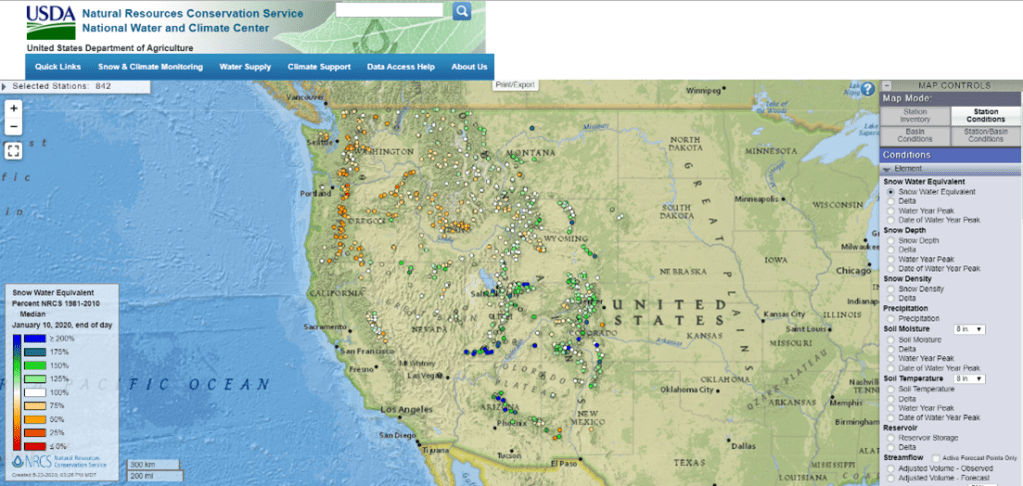
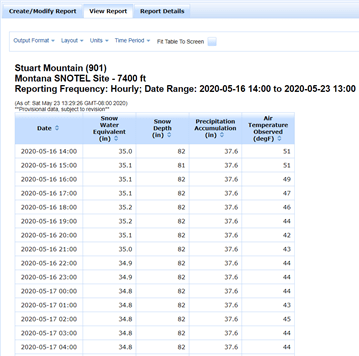
The more modern SNOTEL (Snow Telemetry) is an automated system of sensors installed mostly after 1960 by the US government. These snotel sites report snow water equivalent, temperature, precipitation, and snow depth hourly. The most reliable of these measurements is snow water equivalent, or SWE, which measures the amount of water stored in the snowpack. Snotels measure the SWE of the snowpack by using sensitive pillows that act like a scale, measuring how much water weight lies in the snow above them. Many diehard skiers are familiar with snotels and check them incessantly during a storm to see how much snow their favorite spots are getting. Snotels began reporting SWE from the year they were installed, but temperature gauges were installed later, and most sites didn’t begin reporting snow depth until the early 2000s. This data is also messier. Some sites are missing years of temperature data and snow depth sensors typically bug out during storms and can sometimes be completely unreliable.
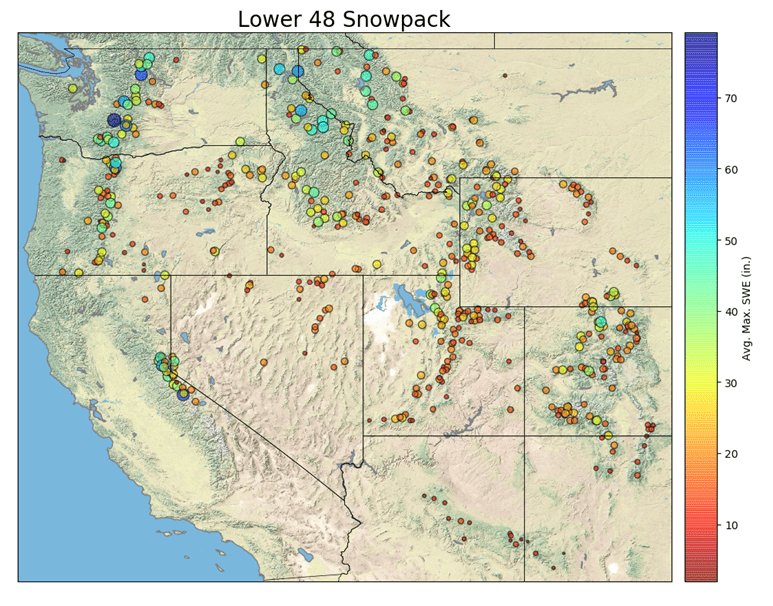
There are more than 800 automated snotel sites in the US. I downloaded the data from every US snotel site with 30 good years of data (1990-2019). I then removed sites with missing years of data which left me with 534 sites across all western states. I looked at a variety of things, but mainly tried to answer the questions that every skier wants to know. Which regions have the highest average snowfall? Which sites are the coldest and which are the warmest? Do some areas go off in November-December but slump in the spring? Where does it melt out the earliest and where can I ski the best July turns?
I used Python to analyze historic and current snowpack data and will post a series of blog posts trying to answer these burning questions state-by-state and in-depth.
Since I’m a grad student in Chemistry, I won’t have much time to dedicate to updating this pet project of mine, but hopefully over the years I can give a reasonably broad picture of snow in the US, how it’s changing, where the best snow is, and how to use these resources to plan your next ski trip.
 The Skientist