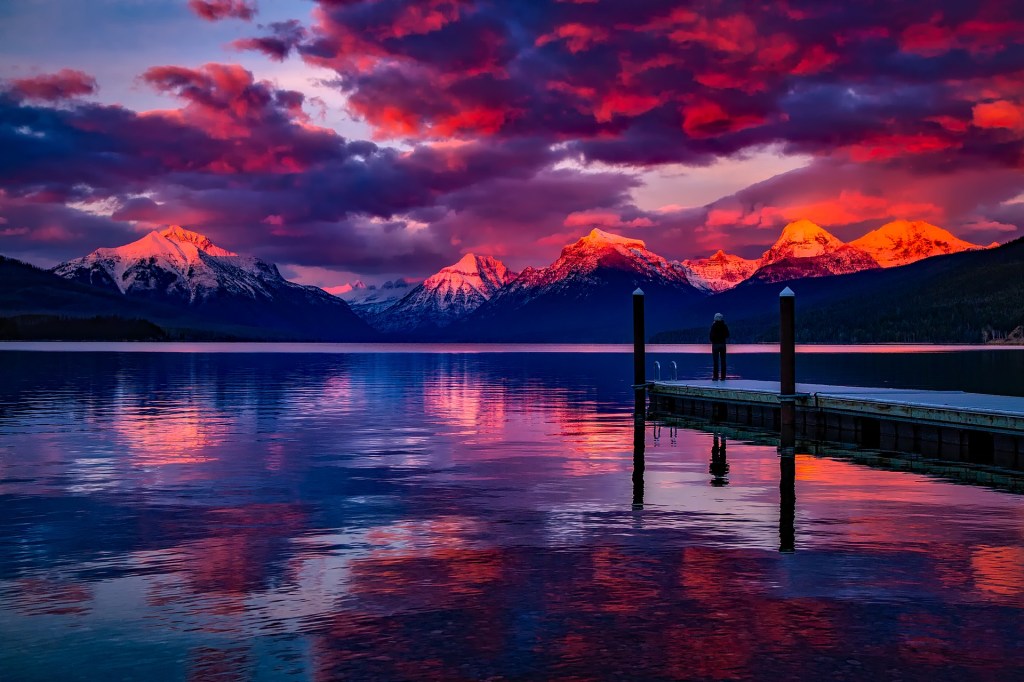
Location: Logan Pass, Glacier National Park
Vertical Gain: 1,200 feet
Inspired by the Missoula legend Don Gisselbeck, who has skied every month for over 13 years, I decided I would try the same. I skied for 20 months in a row before giving up on my streak. It’s possible to find 2,000-foot lines into June, but without traveling to the glaciers of the Cascades or Canada, most summer turns are desperate ones.
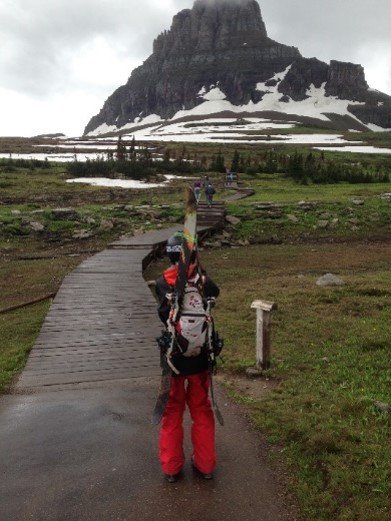
In July 2014, Cody and I headed to Glacier National Park to ski the Logan Pass snowfield below Clements Mountain. We dispersed camped at Hungry Horse Reservoir the night before and drank plenty of beer late into the night. The next morning, we drove up Logan Pass and found snow-packed mountains, lingering from a snowy winter and chilly spring. We donned our ski packs at the bustling Visitors Center, and were met with shocked, contorted faces of tourists confused by our attire on the Hidden Lake Trail. We quickly hiked towards the snowfield overlooking Hidden Lake and began assessing routes. The snowfield had three steep chutes above it, all begging to be skied. The middle chute had a passable bergschrund and continuous snow to the top, so we set our sights there and began our ascent.
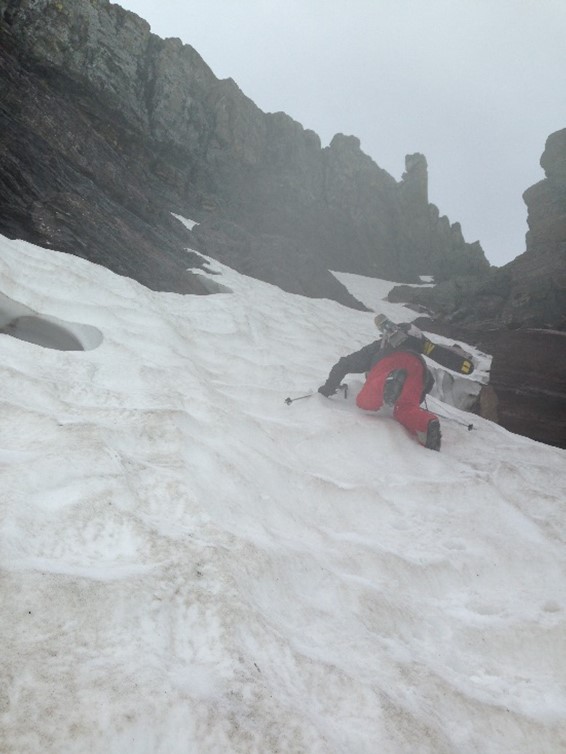
The heavy population of tourists quickly faded behind us as we began bootpacking up the slope. This became steeper and steeper as we approached the bergschrund, leading us to consider turning around and getting great turns without overcommitting. Instead of making the safe call, we crossed the bergschrund on a narrow snow bridge and continued booting up icy summer snow in a 45-degree couloir with exposure. I brought my snowboard and was extremely puckered trying to fit my clumsy snowboard boots into the narrow boot holes Cody was kicking out above me. I used my snowboard to grip the snow as I climbed. My boot would occasionally slip, and only with incredible luck did I avoid tumbling into the crevasse below. It was an especially cold day for July, and occasional graupel showers and wind gusts kept the summer snow icy enough to really wish we had crampons, ice axes, and the know-how to use them.
The chute continued to incline, but we had decided that it was likelier we would fall by booting back down than by continuing upwards. Every step was miserable. If Cody slipped above me, we would both tumble down, possibly falling into the crevasse, or smacking each other with the skis on his back the whole way down. With no safe alternative, we decided to push for the top and pray that we survived this terrible experience. About three quarters of the way up, I thought it might be easier to leave the icy snow and try my luck climbing on loose dirt and rocks, while Cody continued up the narrowest part of the chute. We had a 30-ft fall onto cliffs and ice if either of us slipped. At the top of the dirt-patch, I had had enough, and was in a shallow enough area that I could “safely” strap on my snowboard. Cody made it within 20 ft. of the top but found a spot to put his skis on as well and we both turned around.
Neither of us had any interest in skiing the steep, narrow, icy couloir below us. We were both way over our heads without the proper gear or know-how, and both of us were anxious and wanted nothing but to get off that intimidating mountain. Cody volunteered to drop in first (something I have yet to see him decline) and started making icy turns and side slipping towards the terrifying bergschrund. He slowed down and made a big turn towards the bergschrund when he disappeared from my view. Quickly I heard “SHIIIIIT!!” and then, nothing.

I was already frozen in fear, knowing that I likely didn’t have the skills to snowboard down this chute, and the skier who I knew was more comfortable in steep terrain than me disappeared. He could have been 30 feet under the ice in the crevasse, and I had no idea. After what felt like hours but was likely only 30 seconds, I saw Cody lifelessly sliding down the huge apron below the chute. He came to a stop and still looked like a rag doll on the cold snow below. I called out but he didn’t stir. Knowing that I was the only person who knew he was there, I started putting my snowboard on, panicked, and wondered if I would follow suit. Before I dropped in, he began to stir and slowly got to his knees. I called out to him and he waved. My only option was to go down, so I carefully side slipped down to the snow bridge. I crossed it and began making big turns down to Cody.
Cody was speaking coherently, so we skied down until we hit dirt and walked to the car with the same contorted, shocked faces of the tourists we laughed at. Once at the car, I learned that he had fallen taking the turn before the bergschrund and smacked his head on the icy, far side of the crevasse. Luckily, he ended up on the other side, but slid unconscious until the slope mellowed. When he came to (it had probably only been 15-20 seconds of unconsciousness), he didn’t remember where he was. He didn’t remember the night before. He didn’t remember driving to Glacier or the miserable experience of climbing the chute. He just woke up at the base of a line in Glacier with a pounding headache and a probable severe concussion. The memories slowly returned to him as I made my way down to him, and as we drove down from the pass and back home. After the trauma of the couloir, we decided to name it “F*** that Chute” (though I’m sure it’s been skied and has a more family-friendly name).
In the following 6 years, I improved my risk assessment skills and learned that my ego is not worth an injury or, as was likely here, death.
 The Skientist